Your desktops, with names on the door.
macOS numbers your desktops. Doorplate names them, and keeps the name where you look: in the menu bar, inside Mission Control, one keystroke away. Native Swift. One permission. Nothing leaves your Mac.
Coming soon for macOS 14 Sonoma and later · Apple Silicon and Intel · 14-day trial
Live. Everything below is HTML, not a video. Click a thumbnail to switch, click the desktop to bring Mission Control back, rest the pointer on the top edge.
Names everywhere
One name. Five places.
Set it once, from any of them. The same name, color and icon follow you to every place the number used to be. What follows is the app itself, captured pixel for pixel.
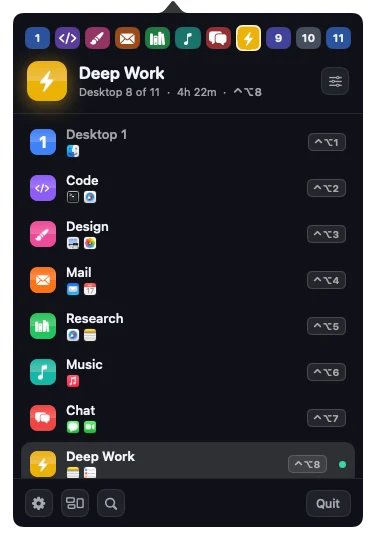
The menu bar
A colored tile and the name of the desktop you are on. Click it for every desktop, the apps living on each, the time you spent there today, and a rename field. Click an app’s icon to land on its desktop with that app in front. On a MacBook with a camera notch, the name can sit flush against the notch instead.
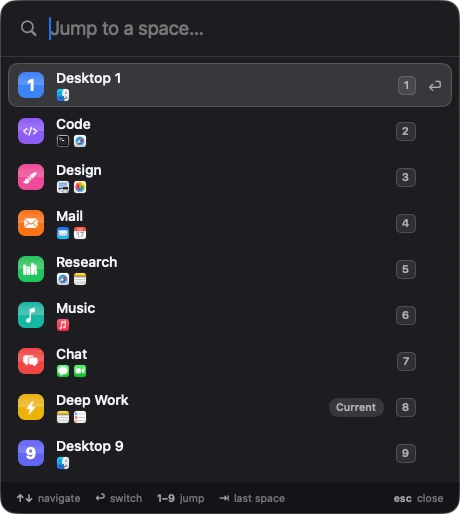
Quick Switcher
Control-Option-Space, a few letters, Return. Finds a desktop by name, by number, or by an app that is on it; name the app and it comes to the front when you land. Tab goes back to the desktop you came from.
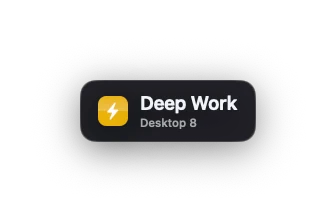
The tag when you land
Land anywhere by swipe, shortcut or click and the name shows for a moment. Center, top or bottom.
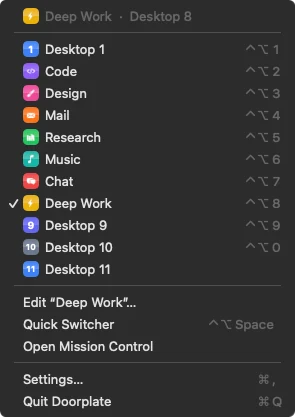
Right-click menu
The compact native version, with the shortcut beside each desktop.

Hover strip
Rest the pointer at the top edge of the screen and a strip of every desktop slides in. Click a desktop to jump, or one of its app icons to jump with that app in front. It listens to mouse moves and does nothing while the pointer is still.
- ⌃⌥1 … ⌃⌥0jump to desktops 1 to 10
- ⌃⌥← ⌃⌥→step between desktops
- ⌃⌥⇥jump back to where you were
- ⌃⌥⇧Nsend the front window to desktop N
- Any keya custom shortcut for any desktop
Shortcuts for everything
Modifiers are yours to change. Global shortcuts are Carbon hotkeys, not a keyboard tap. Desktops past the tenth switch just as smoothly, by name, from the strip, the switcher or a custom shortcut.
Inside Mission Control
The names where “Desktop N” used to be.

Captured from the app on macOS 15.6 at 1x. The pills are Doorplate’s; the row, the thumbnails and the animation are the Dock’s.
Stock macOS, SIP on
Doorplate reads where the Dock draws each label through the Accessibility tree and lays a pill in the desktop’s color over it. No system files touched, no injection, no disabling System Integrity Protection.
Moves with the Dock
The pills slide in with the bar, glide down when the previews expand, and ride out when Mission Control closes. They follow the Dock’s own notifications, not a timer, so they never lag behind it.
Your call where they sit
On the label line under each preview, or inside the preview’s bottom edge. Label unnamed desktops or leave them clean. Prefix the number if you like it.
Built to disappear
Nothing runs while you aren’t doing anything.
Measured as CPU-time deltas on a Mac driving a 5120×1440 display at 120 Hz. These are the numbers we got, so they are the numbers we print.
- Mission Control is noticed by a sub-millisecond window-list read that happens only after recent input, because Mission Control never opens without it.
- Label positions are read only while Mission Control is open, in one batched call per thumbnail, driven by the Dock’s own notifications.
- The only event tap listens for two mouse buttons while Mission Control is open, so the click that closes it can send the pills away with the bar.
- Nothing is written to disk except when you change a setting or leave a desktop; a name is written once, a moment after you stop typing.
How it compares
The honest table.
Checked 7 September 2026 from each product’s public site. If something has changed, tell us and we will fix the row.
| Feature | Doorplate | SpaceJump | Spaceman | Spaces Renamer |
|---|---|---|---|---|
| Names inside Mission Control | Yes, SIP on, Apple Silicon and Intel | Yes (Apple Silicon) | No | Yes, SIP off, Intel only |
| Menu bar name and icon | Yes | Yes | Up to 3 characters | No |
| Quick Switcher and jump back | Yes | Yes | No | No |
| Shortcuts, Raycast, Alfred | Yes, any launcher | Raycast extension | No | No |
| Idle cost published | ≈0.1 % of one core | Not published | Not published | Not published |
| Price | $7.99 once, all your Macs | $9.99 once, 3 Macs | Free, open source | Free, open source |
Pricing
One price. Every Mac you own.
No subscription, no account, no seat counting, no cap on how many Macs. Try everything for 14 days first; nothing is locked during the trial.
- Every Mac you own, one license
- 14-day trial with everything unlocked
- Every 1.x update included
- Names in Mission Control, the menu bar, the Quick Switcher, the hover strip and the tag
- Links for Shortcuts, Raycast, Alfred and friends
Coming soon. The trial starts the moment it lands.
Questions
Short answers.
Does macOS let you rename desktops on its own?
No. Through macOS 26 Tahoe and the macOS 27 betas, Mission Control still labels every desktop “Desktop 1”, “Desktop 2” and so on, with no field to change it. Doorplate adds the name and shows it everywhere the number used to be.
Do the names really show inside Mission Control?
Yes, on Apple Silicon and Intel, with System Integrity Protection left on. Doorplate reads where the Dock draws each label through the Accessibility tree and lays a pill in the desktop’s color over it. The pills follow the Dock’s own animation, so they slide in, expand and leave with the row.
What permission does it need?
Accessibility, once. It is how the app finds Mission Control’s labels and how it switches desktops the way your keyboard does. There is no keyboard tap, no screen recording and no network access.
Will it slow my Mac down or drain the battery?
Measured as CPU-time deltas, Doorplate costs about 0.1 % of one core while idle, about 1 % in active use, and about 3 % for the seconds Mission Control is open. It holds 22 MB of memory. Nothing runs on a timer while you are not doing anything.
Which Macs and macOS versions?
macOS 14 Sonoma or later, on Apple Silicon and Intel. The download is a universal binary.
How much does it cost?
$7.99 once, for every Mac you own, with a 14-day trial of everything. No subscription, no account.
More in the full FAQ.
Put a name on the door.
One small app, no Dock icon, one permission. Your names live in your preferences, not on a server.